
We are excited to celebrate two centuries of Trinitarian Congregational Church throughout 2026. Check here to learn more about our history and for details on upcoming events to ring in our next century.
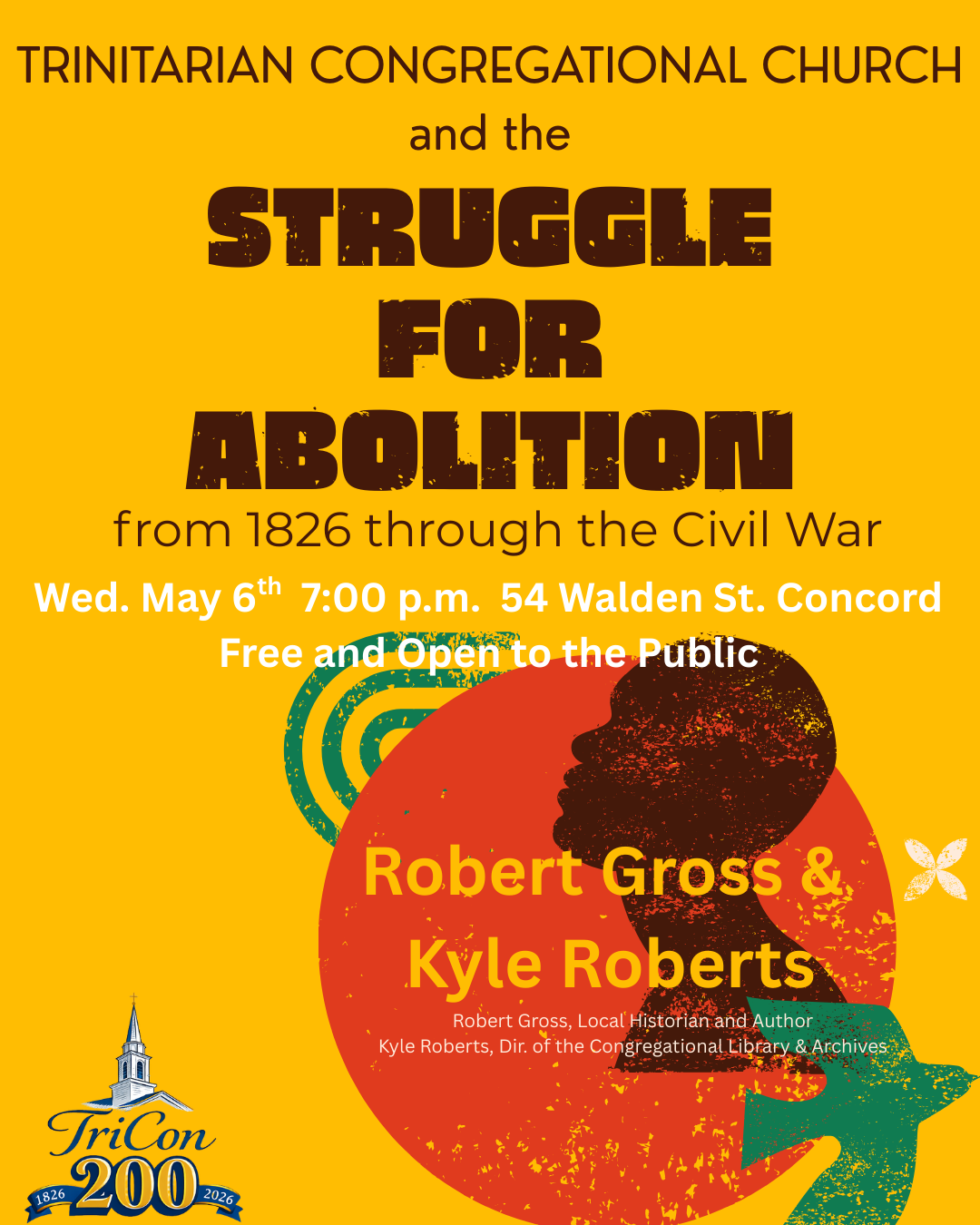
Trinitarian Congregational Church and the Struggle for Abolition from 1826 through the Civil War
Wednesday May 6th at 7pm
Discussion with local historian Robert Gross and Director of Congregational Library and Archive Kyle Roberts

200th All Church Dinner Celebration
Friday June 5th at 6pm
Join us for a celebratory dinner at TriCon to celebrate 200 centuries of worship and service. Catered by Blue Ribbon BBQ join us for a great family event.
200th Worship Event
Sunday, October 4th at 10am
We will celebrate our 200th year in this worship and special coffee hour.
Our 200th Year
In 2026, Concord’s Trinitarian Congregational Church is celebrating it’s 200th year.
The early settlers to Concord established the First Church (“First Parish”) in 1635 based on congregational governance and the authority of scripture in following the life of Jesus and his disciples. By the early 19th century, the First Parish was drifting more and more towards Unitarianism. In 1826, nine members of First Church “crossed the brook” over “the leaving out of the Trinity” and formed an independent religious society that became the Trinitarian Congregational Church.
In 2026, still affirming our belief in Creator, Christ, and Spirit, TricCon Church welcomes all people to worship and share communion. You are welcome here whoever you are, wherever you live, whomever you love, whatever you look like, or wherever you are in life’s journey. We extend our grace and peace to all.
Our stated purpose as a congregation is to worship God; to preach, teach and live the gospel of Jesus Christ; to experience Christian fellowship and unity within the church and the church universal; to celebrate the sacraments; to render loving service toward all of God’s creation; and to work for rightousness, justice and peace. Our church is not just an historic place, but always a living place, and in each new time we are challenged to live into this holy purpose.
In the year ahead we will remember and commemorate the church’s remarkable 200-year history while considering the challenges and opportunities facing us in 2026. We trust that the Spirit is present among us, to help us follow Christ and live out our purpose into our third century.
The Beginning
The early church in Concord was founded in 1635 along with the colony. Until 1833, the church was supported through a tax on the townspeople and all were expected to attend public worship. When Ezra Ripley assumed the pastorate of the Concord Church in 1778, a position he was destined to hold for the next 63 years, he began to move the Church away from a strict Calvinistic theology and toward a more liberal stance, relaxing the rules to attract members.
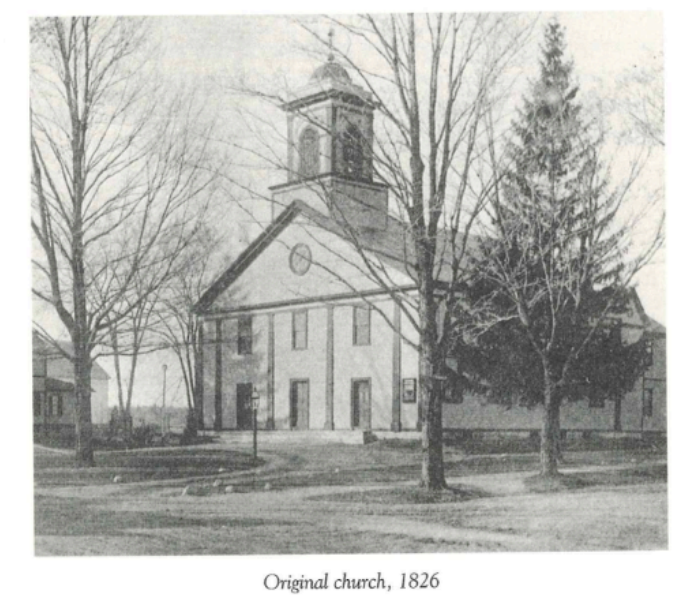
In 1825, seeking a return to a more active spiritual life the more orthodox viewpoint, a small band led by the Thoreau sisters, Jane, Elizabeth, and Maria (aunts of Henry David), began holding a series of prayer meetings in houses in the village. In early 1826, they and five others, petitioned to be removed from the rolls of what had become known as Dr. Ripley’s Church. Plans were immediately underway for construction of a meeting house on land donated by Ebeneezer Hubbard.
In a gesture of goodwill, First Parish allowed the use of its meeting house on June 5, 1826 where the Rev. Lyman Beecher, minister of Hanover Street Church, Boston, a leader of the orthodox movement, and father of Harriet Beecher Stow, was the preacher, and the Trinitarian Congregational Church was established. This spirit of congeniality between the churches was short-lived. Differences and divisions between the parishes continued, as First Parish moved father from the orthodox creed and affiliated with new the Unitarian denomination. The split was especially disappointing to Rev. Ripley who had struggled mightely to unite this flock. Ironically, when he succumbed to his death in September of 1841 at the age of 90, the service was held at Trinitarian Congregational Church, due to renovations happening at First Parish at the time.
Early Groups in Our Church
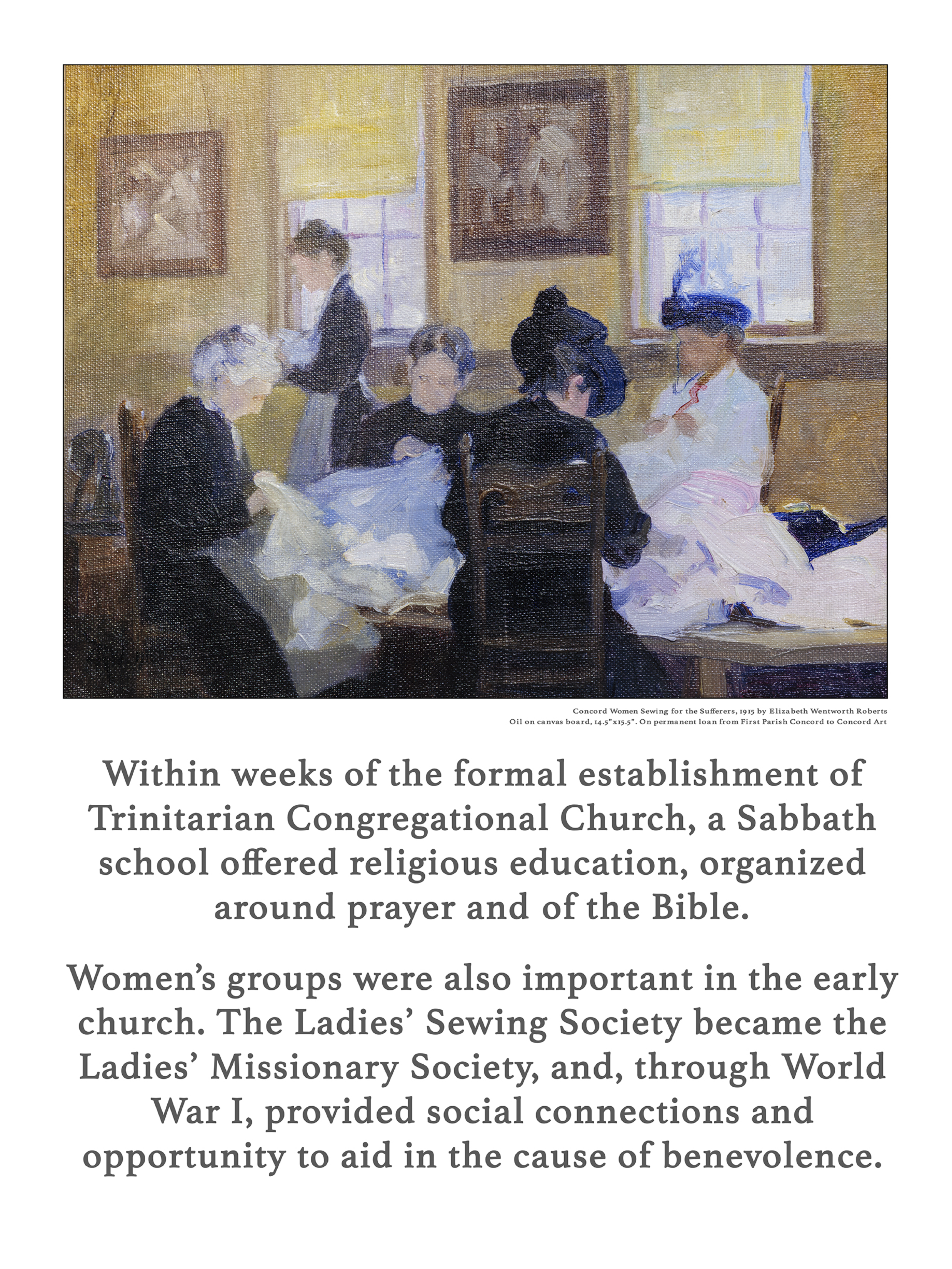
Within weeks of the formal establishment of Trinitarian Congregational Church, the congregation voted to establish a Sabbath-school to offer religious education and instill moral values. The school was organized around prayer and reading of the Bible. The older children used “question-books”, providing lessons and questions on Biblical topics while the youngest scholars recited passages from the Bible. In 1828, the church voted to resolve itself into the Concord Sabbath-school Society and founded branches throughout the town.
The schools, overseen by a superintendent, were largely taught by volunteers, primarily women and enhanced literacy as well as fostering religious knowledge. In 1832, Congregationalists founded the Massachusetts Sabbath School Society that provided curriculum and library books to the area churches, including ours.
Women’s groups were also important in the early church. Mrs. Southmayd, wife of the first minister, established a weekly female prayer meeting and a monthly Mothers’ meeting, both efforts designed to contribute to the “spiritual good" of the church. In 1828, The Ladies’ Sewing Society, later to become the Ladies’ Missionary Society, included 43 members, and provided social connections as well as an opportunity to fulfill their stated purpose of “desiring to aid in the case of benevolence., according to the ability which God giveth, we whose names follow, agree to associate together for the purpose of gathering from the avails of our industry an offering for the treasury of the Lord.” Their treasure consisted of sewn and knitted clothing to be distributed to the needy in the town and beyond.
Out of this effort, was born the Misses’ Sewing Society for girls ages three to ten, later expanded to the Juvenile Bible Society to better reflect is stated purpose of the Bible. At the meetings, members gathered for needlework and the readings of selections that illustrated “the necessities of the destitute and the condition of those living in the heathen lands.” Other missionary efforts included the Bible Union, the Juvenile Missionary Society, the Sabbath School Missionary Association, all stemming from a desire “to train the young in the habits of benevolence.”
TriCon Church in the Post Civil War Era
Following the civil war years, “the church held itself warmly alive to the high interests of unity and liberty.” Many of the women joined the Soldiers’ Aid Society to provide for the needs of the veterans. The clergy leadership during that time was uncertain with a number of short-term pastorates.
Stability returned when in 1872, Rev. Henry Martyn Grout accepted the call at a salary of six hundred dollars. In that same year, Hubbard Street was laid out resulting in advantageous redrawing of the church property. The building also saw changes - adding stained glass windows, chandeliers, furnaces and a slate roof. The center aisle was eliminated in favor of side aisles along the walls.
In 1876, The church celebrated its jubilee- the first half century with worship services and celebrations and a historical discourse preached by the pastor on Samuel VII:12 “Hitherto hath the Lord helped us.” In that same year, the last two pews in private ownership were bought back with congregants now sitting as to personal preference and all contributing to the support of the church.
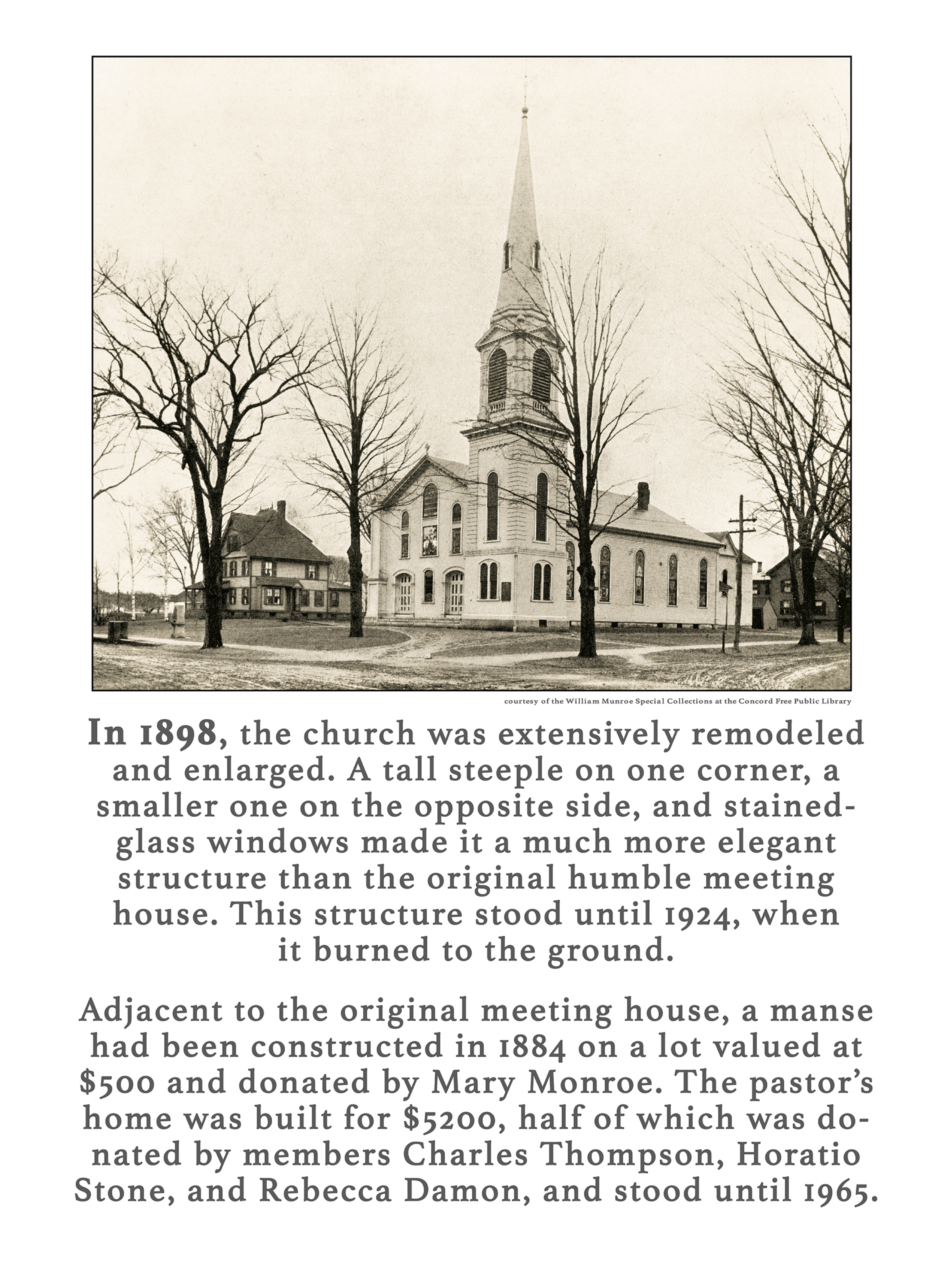
In 1884, a Manse was constructed on a plot on the south side of the church given by Miss Mary Munroe. This was a long-felt need as previous pastors needed to rent or take lodgings in homes in town. Described as a “large and pleasant structure, square in general form, of two and a half stories and furnished with modern conveniences,” the house was built at a cost of $5,607.09
Also in 1884, at the annual meeting of the Ladies Missionary Society, initial steps were taken to meet the “growing need of larger and more appropriate accommodations” for ladies’ meetings and large gatherings. A committee was formed and a second story was added at the rear of the meeting house providing ample space for a kitchen, ladies parlor, and reception room/dining hall.
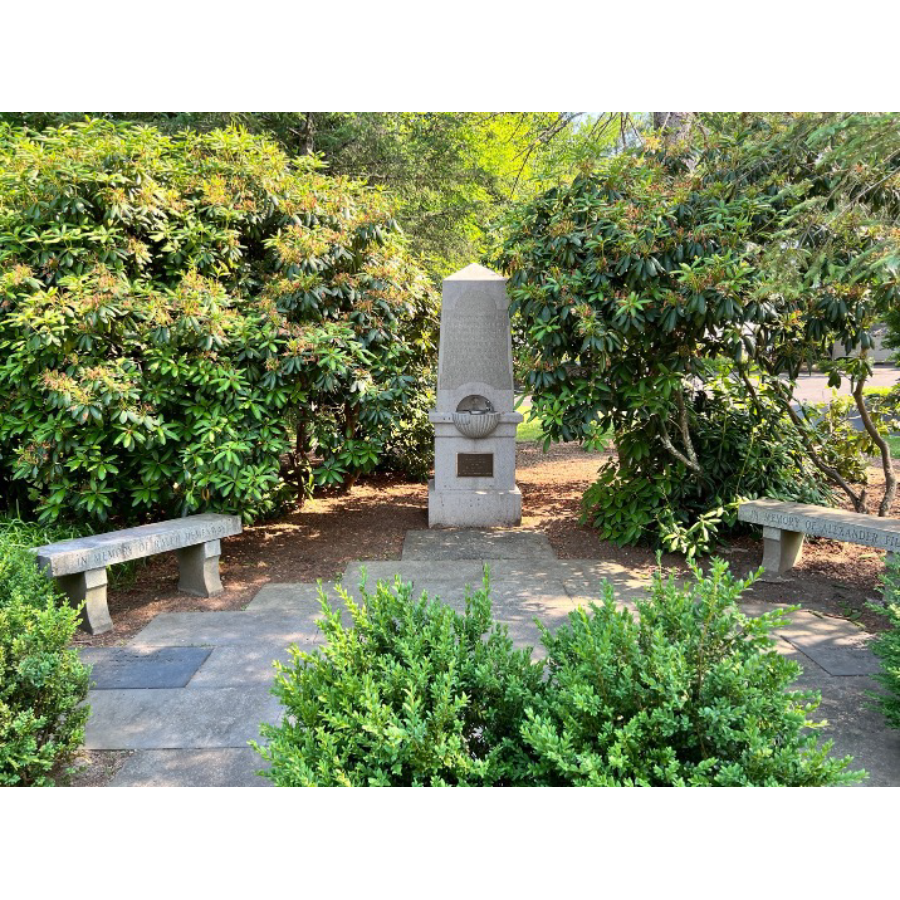
In 1886, at a Friday evening prayer meeting, Rev. Henry Martyn Grout expressed interest in having a drinking fountain on the church grounds with a Biblical inscription that could serve as a “perpetual preacher.” Less than a month later, Rev. Grout died unexpectedly, following a brief illness.
The following year, a drinking fountain “of plain, yet comely style” was dedicated in his honor and placed immediately in front of the sanctuary and a watering trough (inscribed 1887) was placed near the road.
The fountain had the inscription suggested by Rev. Grout - "Whosever drinketh of this water shall thirst again; but whosever drinketh of the water that I shall give him shall never thirst; but the water that I shall give him shall be in him a well of water springing up into everlasting life." John 4:14
On the reserve, was the inscription, “In Memory of Henry Martyn Grout, D.D. Pastor 1872-1886 By his Sorrowful Church.”
In the1960’s, the fountain was damaged and it was moved to an obscure location on the church property and the horse trough went missing. In 2000, as part of a major building and site renovation, the fountain was repaired and moved to its present location in the memorial area on the lawn and the horse trough, discovered buried under the parking area, became a planter at a location just yards from its original location.
TriCon Church - the Second Building
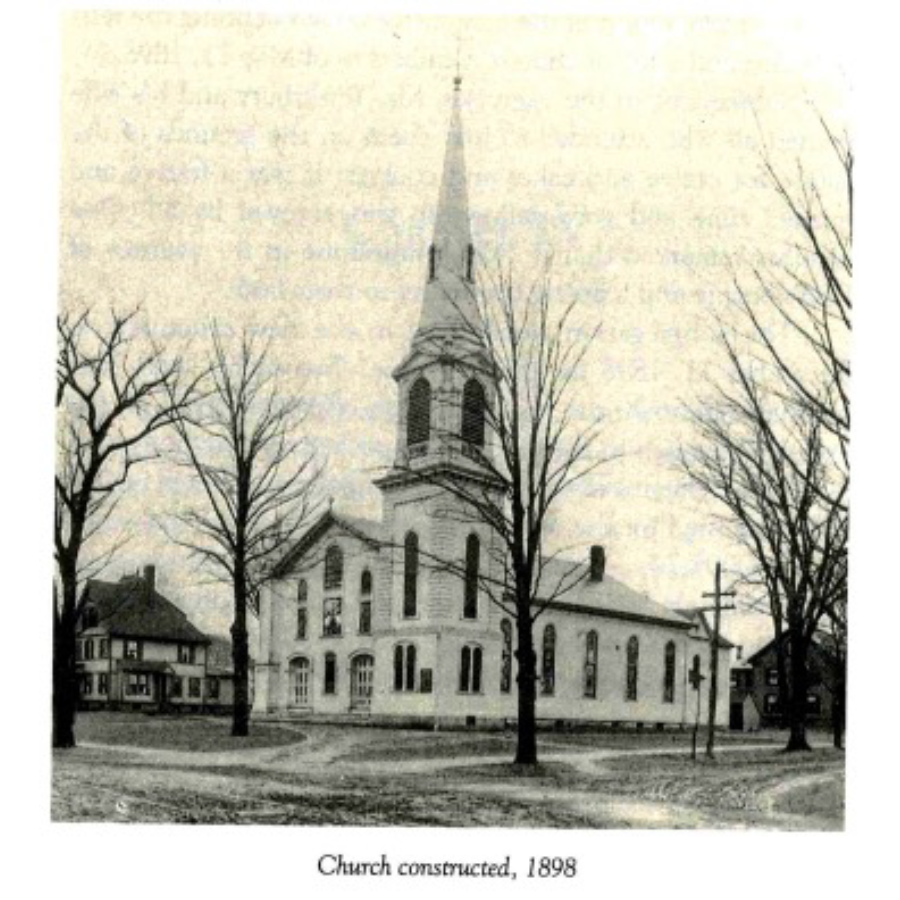
A special report issued by the Standing Committee in 1896, informed the church that the time had come to make major renovations. An architect was hired to draw up a plan and an estimated cost. After a presentation by the architect in 1897, the congregation voted unanimously to go forward “with cordial enthusiasm and courage”.
In 1898, the church signed a contract with a builder from Fitchburg to construct a new edifice. Grant blocks that had supported the no-longer-needed railroad turntable at the corner of Thoreau Street and Sudbury Road were used as foundation stones for the enlarged church building.
The corner stone was laid in May 21st, 1898 and in his address to the congregation, Rev. Tewksbury stated, ‘We give our allegiance anew to the gospel which our fathers in Christian loyalty and love, and with a measure of sacrifice greater than is required of us, built this house to perpetuate. The stone we now put in place has the same significance as that that was laid seventy-two years ago – it suggests no departure from the essential truth which began to be taught in this house and from which the church has not swerved throughout the intervening years.”
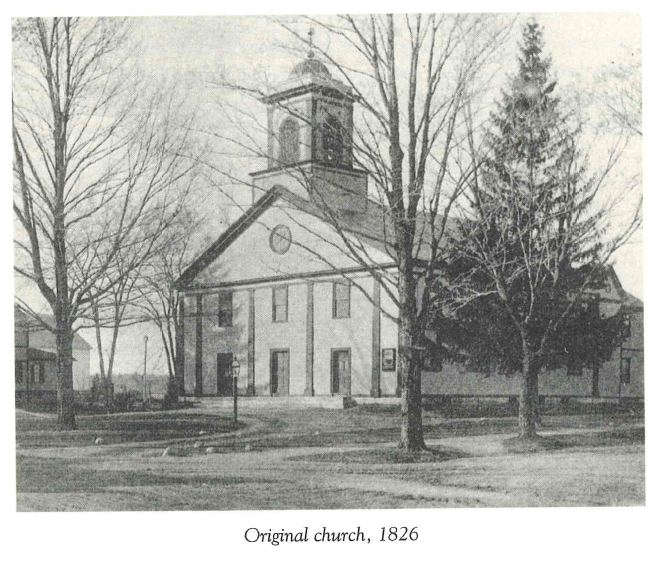
An addition of thirty-one feet to the front end gave it a length of ninety feet, retaining the original width of fifty-eight feet. A spire on the northeast side rose one hundred and thirty-five feet and contained the new bell, which had been funded by selling shares at ten dollars (about $400 today). The bell, which combined with the yoke, clapper and mountings weighed about 3,000 pounds, had a “rich resonant tone in the key of F that was easily heard in remote parts of town”. In the photo, smaller spire can be seen of the southeast side just peeking over the roofline. The manse build in 1884 stands next to the church.
The new structure featured a beautiful panel ceiling, stained glass windows in “varied and tasteful design,” a new Hutchings organ with a water motor, new circular oak pews, “easily seating six hundred” and arrangements for steam heat and electric lighting. The entire cost of the renovation was $18,005.20.
The Abolitionist Movement
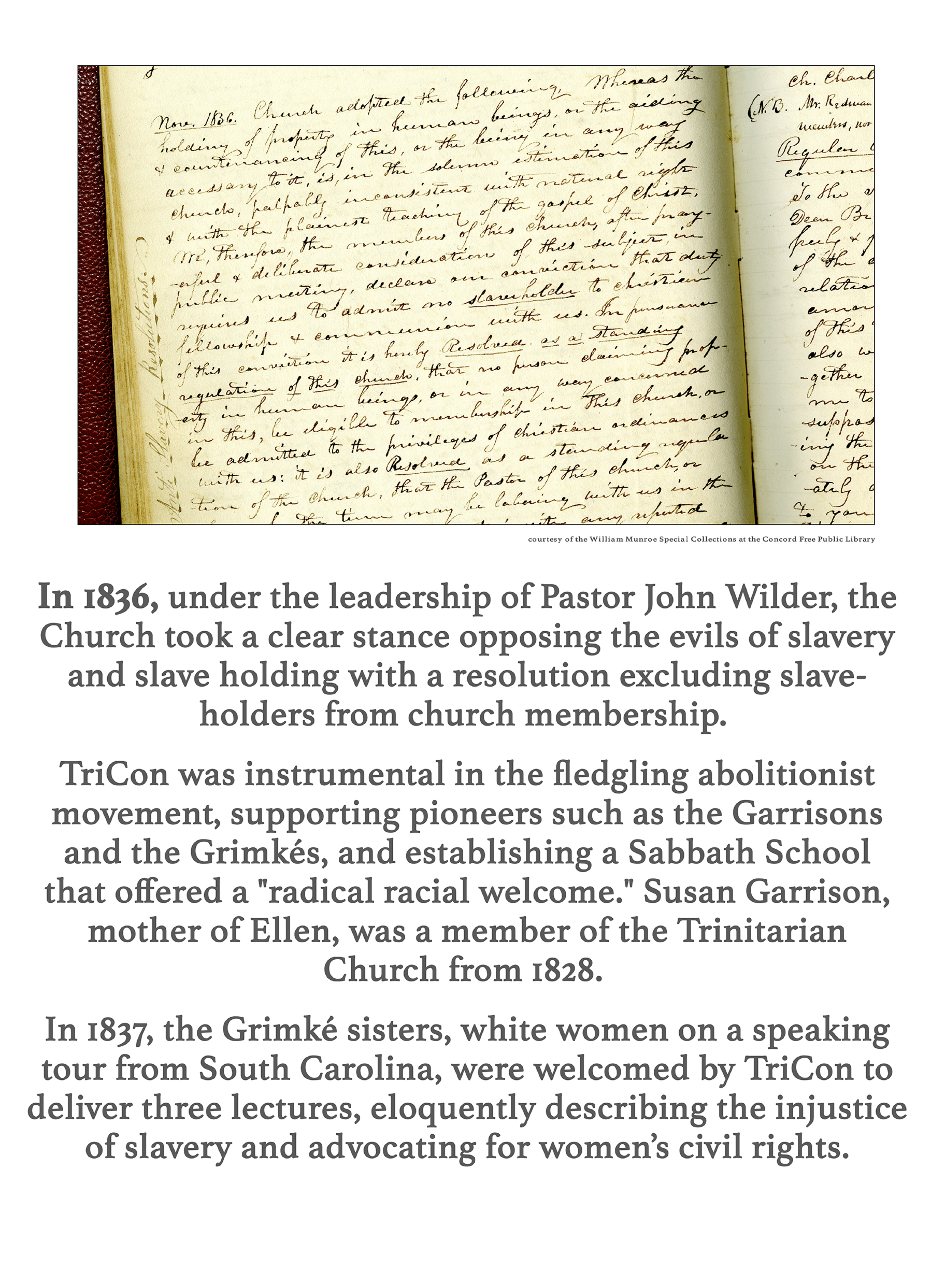
In November 1836, during the ministry of Rev. John Wilder, who served the church from 1833 -1839, our church took a clear stance on slavery and voted:
Resolved as a standing resolution of this church, that no person claiming property in human beings, or in any way concerned in this, shall be eligible to membership in this church, or shall be admitted to the privileges of Christian ordinances with us.
Resolved as a standing regulation of the church, that the pastor of this church, or whoever for the time being may be laboring with us in the ministry, be requested not to invite any reputed minister of the gospel who is a slave holder, or is in any way concerned in slave holdings, to preach the gospel or perform any of the duties of the ministry to this church.
In 1837, Concord women gathered to form the Concord Female Anti-Slavery Society. Its founders included 17 members of our church’s Ladies Sewing Society. That same year, Angelia and Sarah Grimke, sisters, from a South Carolina slave-holding family, visited Concord to speak out against slavery, as well as the laws and customs that constrained the rights of women. In a break from the conventions of the time against women speaking publicly, Angelina Grimke gave four very well-attended lectures in our meeting house on the injustice of slavery.
Four years later, the female members of the church started the Ladies Emancipation to relieve “those held in bondage and for removing this iniquity from our land”. The Society collected clothing and raised money to be sent to escaped slaves in Canada.
On May 6th at 7pm in our sanctuary, noted author and historian, Robert Gross, and Kyle Roberts, Executive Director of the Congregational Library & Archives will share much more about this time in our church’s history and the abolitionist movement in Congregational churches in New England.